Everything I Haven't Said
Or rather: a compilation of half-drafts and unvarnished breakdowns dating back to 2023

Sometimes self-care is realizing that no matter how much I love language and intellectual rigor and genuine sociological observation and ambition and honesty—the world isn’t in a desperate state because no one put the words just right. Like, this is not happening because Bethany C Morrow didn’t succeed at making it plain. The world is this way because enough people either want it to be or don’t want to be bothered to stop it from being. Or hope they’ll profit from it.
So I’m committing to not finishing these drafts, and instead bringing them together in less a sociopolitical meditation and more an anthrobiographical study of my own interior considerations. These are the things that it pains me to see denied or downplayed, because I know it means we’ve not turned back from evil while they are.
Anyway. Pretend this is the bins at the thrift store or scribblings on some ancient wall. Whatever it takes to make this useful or interesting in some way, so I can try to release them and free up some cognitive space.
October 2025
There was a point, you see, to the incredibly stupid and unserious conflation of feelings and facts, to the ignorant and offensive constant debate over whether racist things are racist. Gaslighting, yes, but there was more. The point was to turn what can be tracked and traced and observed into something that feels subjective and esoteric. That is how you get to rulings on whether the Voting Rights Act is “racist towards whites.” (Quotes lest you forget that racism is not possible toward whiteness.)
Discrimination and the rulings and legislation intended to combat it were based on the recognition that racism has an effect. There is an impact. Because racism is not accidental. The impact is the point. You’re not trying to express personally held feelings about an individual, you’re trying to ensure that your personally held feelings impact the individual’s life, livelihood, and sometimes mortality. And when you’re part of the power majority, the race for whom racism and its accompanying violence was created, you’re using intentionally created and integrated systems to make sure individuals of an entire racial demographic are impacted. (Even if some dolphins get caught in the tuna net.)
For the intellectually honest, there is no amount of linguistic gymnastics or bad faith Kirkian “debate” that can obscure the reality of racism and the discrimination hardboiled into the American system. They work—those tactics—only because people want them to.
[Abandoned because exhaustion.]
Early 2025
Years ago, a Russian-born man who worked as a US Border Officer wanted a romantic relationship with me. I found this out two days before my cross-country move. We’d been neighbors for two years, and he’d harbored this interest the entire time, having asked around our small community to learn my name and my occupation. Apparently, he was waiting for fate to step in, and during our first conversation—during which he found out about my impending move—he told me all of the above.
The next day he told me two things. First, that there was “no such thing as Ukraine.” Second, that the US would never be peaceful because there is too much diversity.
This sentiment. It’s so close to the truth as to seem reasonable, at first. And then, rather quickly, it’s despicable.
The implication of course is that difference breeds discord. That various cohabitating ethnicities result in inevitable conflict. It implies that throughout history, we have all stayed in our own corners of the world and, if we did cross paths, conflict ensued.
Two things. A) It intentionally erases the impact and sin of imperialism and colonization. Discord is the fault of diversity, not violent conquest. B) It intentionally disregards all homogenous violence, as it would imply that perhaps human nature is to blame and not race.
[There was no need to complete this because an anthropologist substack’d it better.]
Late 2024
First things first: Discrimination is systemic disenfranchisement, and is therefore visible in the data. Even where the means of discriminating have been made invisible by automation, the evidence is in the outcome.
When resources and initiatives are designed specifically to benefit the disenfranchised, how are they then labeled discriminatory toward the established power majority? Well, you begin with what I like to call Garnish Diversity (spoiler: I never get back to this), through which you actively conflate equity with equality.
Equality means everyone is treated the same. Equity means adjusting things so that everyone is treated fairly.
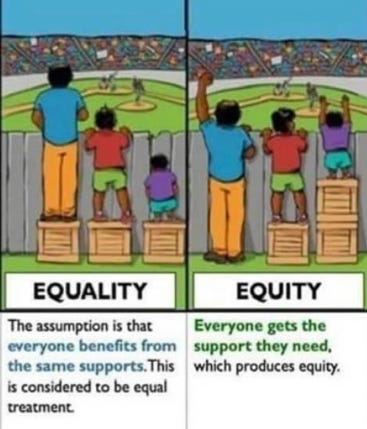
There are consequences to glossing over the sins of a country by skipping straight to equality, without acknowledgement of the intentionally created disparities. Attempts to correct for these unacknowledged damages are immediately and effectively combated on the basis that they are unfair. (No, this does not require the institution to actually believe this. People can say things they know are untrue! Even on the internet!) Precisely because those disparities and their equivalent privileges actually do exist, those feelings of unfairness are enough to halt the corrections. No proof required. You need not demonstrate the outcome evidence that white men are being disenfranchised. You need not assess their rate of employment, acceptance, pay, etc, and demonstrate an observable disadvantage among the population, as you were able to do for the minoritized. They are given a different definition and metric to determine discrimination—and spoiler: it’s feelings.
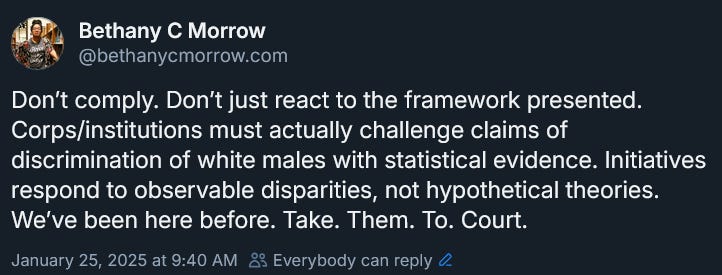
Accusations of “reverse-racism” and anti-white discrimination have long existed. As Franklin Leonard is credited with saying, when you’re accustomed to privilege, equality feels like oppression.
The issue, of course, is that the reverse of racism is anti-racism. (Dr. Ibram X. Kendi) And having your institutional privilege counteracted with measures to create equity for others is not anti-white discrimination. The problem is what it’s always been. The feelings of white people (invested in white supremacy) have always been permissible in court, so to speak. A claim can be made on the basis of how whiteness feels about equitable measures being taken, and it is treated as evidence.
[Here would’ve gone the rest of this essay but for the cost to my sanity and the loss of required bandwidth. And don’t worry, Bethany tweet: they’re coming for the courts, too.]
If you’ve seen any version of the Equality/Equity cartoon, read Richard Leong’s essay, “The Problem With That …Cartoon You’re Sharing.”
December 2023
The amount of honesty required to acknowledge that discourse (an unnecessary but claimed sacrisanct model), and more importantly, equity requires separately assessing both what was done and what they are doing in reply—simultaneously—is currently unavailable. The farce of accountability, uninterrogated through the lens of abolishing and dismantling white supremacy, requires taking a hard line about what was done (Black Harvard professor’s alleged plagiarism)—regardless and irrespective of what THEY are doing in reply. Which is using a separate and extreme set of standards and punishments reserved only for those who should not have been allowed certain things in the first place. To think that this second part, the mechanism itself, can be ignored—the way that some from the class/caste being lynched would “concede” that error *was* made—is to recognize how remedial and base this whole society truly is.
[This can best be described as an exorcism. A necessary expelling, rather than a useable or widely comprehensible thesis. I didn’t even get to the point of making it clear, this was just radioactively green pea soup projectile-vomited against the screen.]
Me now, in October 2025:
So…
How are you?
Please accept this picture of me at NYCC for having read or scrolled this far.